 By Juraj · Last updated March 29, 2026
During a used car inspection of a Skoda Octavia Mk3 2.0 TDI DSG, we discovered something that immediately raised suspicion.
While scanning the car we found a value of roughly 600,000 km stored in the DSG transmission ECU, while the dashboard odometer showed only about 215,000 km.
At first glance this looks like a classic odometer rollback situation. But before jumping to conclusions, it's always better to check what the rest of the car is saying. Modern vehicles store mileage information in several control modules, and comparing those values can reveal whether the mileage is authentic or not.
So instead of relying on a single parameter from the transmission, we decided to pull mileage data from multiple ECUs and reconstruct the vehicle history.
This article walks through that real diagnostic case and explains how we determined whether the 600k DSG value actually meant the car had extremely high mileage.
I earn from qualifying purchases and sometimes get tools for free (full disclosure). It never affects my scoring.
Used tool in this guide

For this inspection we used the iCarsoft CR Max.
One feature I really like on this scanner is the Mileage Verification function, which automatically retrieves mileage values from multiple control modules.
Video: Reading mileage data from Skoda Octavia MK3 using icarsoft CR max
Without this feature you would normally have to manually open modules like:
- infotainment
- body control module
- steering module
- ABS
- gateway
- transmission
…and search for mileage parameters in each one individually.
The CR Max simply gathers those values in one place, which makes this type of inspection much faster.
Step-by-step procedure
Vehicle overview
| Item | Details |
|---|---|
| Vehicle | Skoda Octavia Mk3 |
| Engine | 2.0 TDI |
| Transmission | DSG automatic |
| Model year | ~2020 |
| Dashboard mileage during inspection | ~215,553 km |
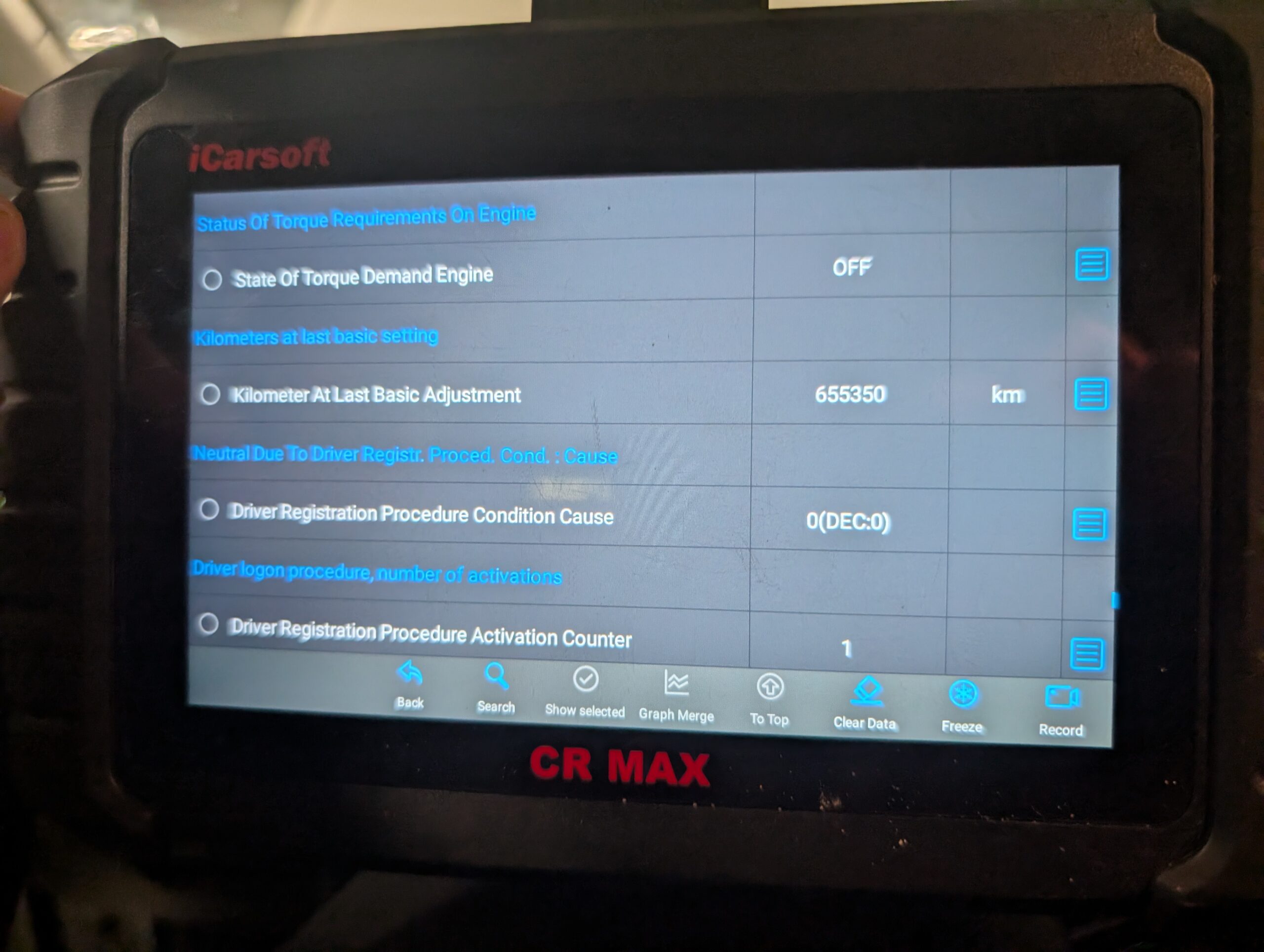
The investigation started because the transmission ECU reported a value of 655,350 km, which clearly didn't match the dashboard mileage.
Mileage values stored in other control modules
The first thing we did was compare the mileage stored across different ECUs.
Here are some of the values retrieved from the vehicle:
| Module | Stored mileage |
|---|---|
| Climate Control | 215,476 km |
| Central Electronics | 215,476 km |
| Steering Column Lock | 215,476 km |
| Power Steering | 215,476 km |
| Parking Assist | 215,476 km |
| Infotainment (5F) | 215,550 km |
As you can see, the numbers are almost identical to the dashboard mileage.
This is usually a very good sign. When mileage values stored in multiple ECUs match the dashboard, it strongly suggests that the odometer reading is genuine.
If the vehicle had been rolled back, it's common to find at least one module storing a higher mileage than what the dashboard shows.
In this case, none of the modules showed a higher value.
Historical mileage records stored in ECUs
Some control units store mileage when specific events occur. These records are extremely useful because they allow us to reconstruct the vehicle's history.
Here are some of the historical values we found.
| Event | Stored mileage |
|---|---|
| Anti-theft system history | 209,156 km |
| Steering assist activation | 214,195 km |
| Voltage history snapshot | 172,286 km |
These numbers create a perfectly logical timeline leading up to the current mileage.
This kind of chronological progression is exactly what we expect to see on a vehicle with authentic mileage.
DSG transmission data that triggered the investigation
The investigation actually started because of the following transmission values.
| Parameter | Value |
|---|---|
| Snapshot mileage | 187,530 km |
| Kilometer at last basic adjustment | 655,350 km |
| Gearbox mileage | -59,092,992 km |
| Engagement counter | 2,147,483,647 |
The value 655,350 km immediately looked suspicious and could easily make someone think the car actually has over 600k km.
But the rest of the transmission data clearly shows that these counters cannot be interpreted as real mileage.
For example:
- the gearbox mileage shows a negative number
- the engagement counter is 2,147,483,647
That last number is important. It is the maximum value of a signed 32-bit integer, which usually indicates counter overflow or corrupted data.
This strongly suggests that some of the DSG internal counters are invalid or corrupted, rather than representing the real mileage of the car.

Engine operating hours analysis
Another useful piece of information is engine operating time.
The engine ECU reported approximately 3036 operating hours.
Using that value we can estimate the vehicle's average speed.
215,553 km ÷ 3036 hours ≈ 71 km/h
That is a perfectly reasonable average speed for a diesel vehicle used in mixed driving conditions.
If the car actually had 600,000 km, the engine operating hours would normally be much higher.
This calculation again supports the conclusion that the real mileage is close to the dashboard reading.

Reconstructing the vehicle timeline
By combining the ECU records we can build a rough timeline of the vehicle.
| Mileage | Event |
|---|---|
| 128,840 km | DSG clutch adaptation procedure |
| 172,286 km | Voltage history snapshot |
| 176,240 km | Driver registration procedure |
| 187,530 km | DSG snapshot fault |
| 209,156 km | Anti-theft system history |
| 214,195 km | Steering assist activation |
| 215,553 km | Current mileage during inspection |
Everything in this sequence follows a logical progression, which is another strong indicator that the mileage hasn't been manipulated.
Final verdict
Despite the suspicious 655,350 km value found in the DSG transmission ECU, the rest of the diagnostic data tells a very different story.
All major control modules store mileage values around 215,000 km, historical records increase logically over time, and engine operating hours match the expected mileage.
Because of this, the most likely explanation is that the transmission ECU contains corrupted or overflowed internal counters, rather than evidence of extremely high mileage.
Based on the available ECU data, the most probable real vehicle mileage is approximately 215,000–216,000 km, and there is no strong indication that the odometer was manipulated.
Legal & safety notice
More procedures like this
How to Check Real Car Mileage With an OBD2 Scanner
How to Check Real Mileage – Skoda Rapid 2019 (OBD2)
Škoda Kodiaq 2023: How to Disable the Seatbelt Warning Chime
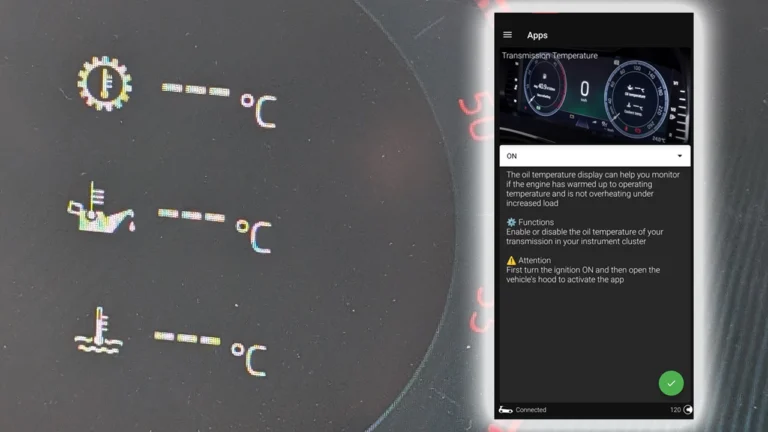
How to display gearbox, oil and coolant temperatures in the Virtual Cockpit on Skoda Octavia 4 (NX)
How to deactivate the seatbelt warning chime on Skoda Octavia 4 (NX)
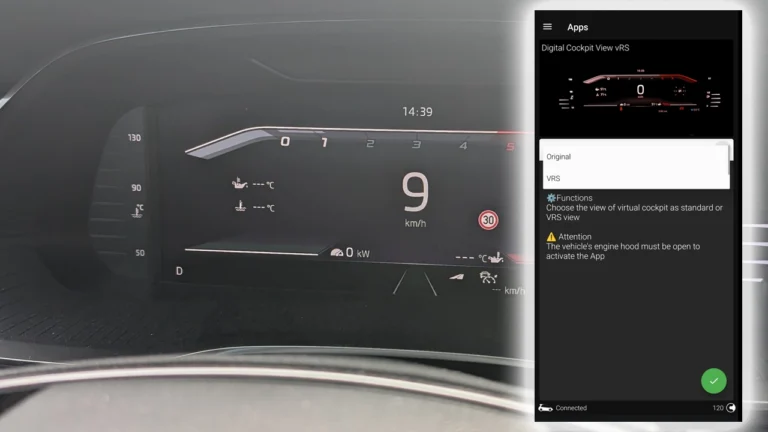
How to enable VRS sport display in the Virtual Cockpit on Skoda Octavia 4 (NX)
Most popular OBD2 guides





I'm Juraj Lukacko and I work as an auto electrician. On this site I share what I learn from real work on real cars, to help you pick the right tools for diagnostics, programming and tuning and get the job done.
More about me →
I’m curious as to what identifiers for tampering that I should be looking for when using one of these on a used car I’m intending to purchase? I’m sorry if this is an overly asked question.
Hi go over live data in all modules and try to find any mileage records or anything that can help you estimate mileage like working hours, number of starts, etc… But note that not all cars store this data, there is a chance you will find nothing.
By coincidence I saw your site on OBD scanners and find it very interesting, I have had Citröen cars no. 10 and used Diagbox on old pc that can not be updated so I bought an iCarsoft CR Max for use on my C4Picasso 1.6 THP which have and are known to have many failures all over the car so I am quite busy just to have it driving daily;-)
My friend has two of those in shop, they never work 😀