
How to fix DPF warning, glow plug blinking and limp mode on Skoda Rapid 1.6 TDI (2014)
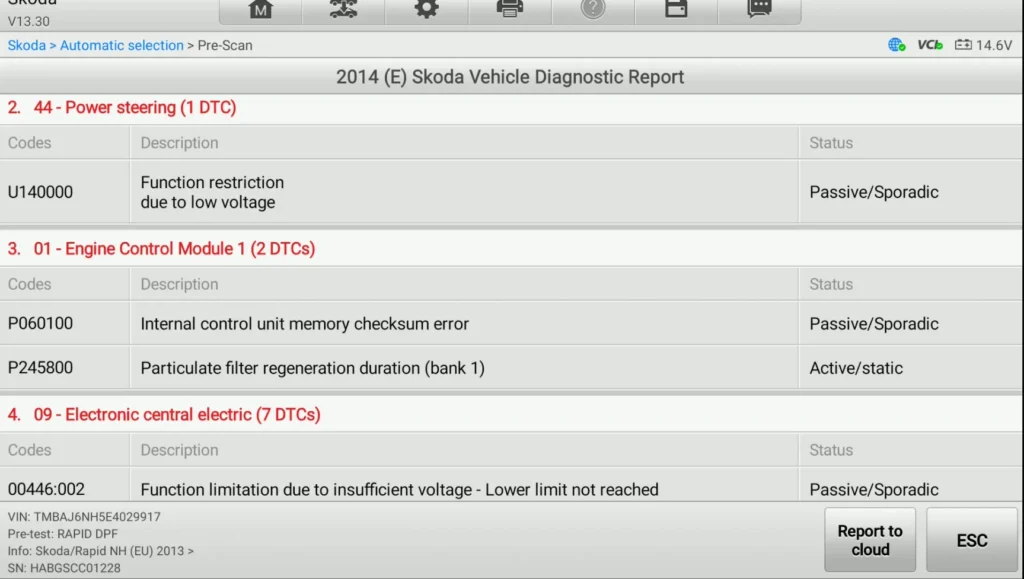

This guide shows how to fix DPF warning, glow plug blinking and limp mode on Skoda Rapid 1.6 TDI (2014) by performing DPF regeneration and DPF adaptation/reset using diagnostic tool.
Affiliate Disclosure: iamcarhacker.com is an Amazon and other affiliate programs Associate. As an Amazon Associate, I earn from qualifying purchases. Full Affiliate disclosure.
Used tool in this guide

Supported vehicles
| Vehicle |
|---|
| rapid-nh |
- Similar VAG vehicles with 1.6 TDI engines and DPF system
Video: How to do service DPF regeneration on VAG 1.6 TDI
This video shows how to service DPF regeneration on VAG 1.6 TDI using VAG guides functions on OBD2 scanner.
Technical overview
| Item | Details |
|---|---|
| Vehicle | Skoda Rapid 1.6 TDI |
| Year | 2014 |
| System | Engine Control Module (ECU) / DPF |
| Procedure type | DPF regeneration + DPF adaptation/reset |
| Difficulty | Intermediate |
| Time required | ~30–45 minutes |
| Prerequisites | Engine warm, diagnostic tool with guided functions |
Step-by-step procedure
1. Read fault codes
From scan:
- P245800 → Particulate filter regeneration duration (bank 1) → ACTIVE
- U140000 → Low voltage (sporadic)
- P060100 → Internal ECU checksum (sporadic)
👉 Key issue:
- DPF-related fault active → blocks proper regeneration
2. Attempt DPF regeneration (diagnostic tool)
Navigate:
01 Engine → Guided Functions → DPF Regeneration
You will see warnings like:
- regeneration should NOT be performed if faults are stored
- ECU event memory contains entries
👉 You continued anyway (valid for testing)
3. Monitor regeneration live data
From your screenshots:
Before regen:
- Calculated soot: ~24 g
- Measured soot: ~2.09 g
After regen:
- Calculated soot: ~23 g
- Measured soot: ~0.62 g
Temperatures:
- Before turbo: ~300–400°C
- Before DPF: ~270–309°C
- After DPF: up to ~408°C
👉 What this tells us:
- Measured soot already LOW → DPF not actually clogged
- ECU still thinks regen problem exists → software/adaptation issue
4. Regeneration result
- Regeneration ended as FAILED
- Fault code P245800 remained active
- Check engine light could NOT be cleared
5. Key diagnostic insight
👉 This is NOT a clogged DPF problem
👉 This is DPF adaptation / learned values issue
6. Perform DPF reset (adaptation)
Navigate:
01 Engine → Guided Functions →
Particulate Filter → Adapt Diesel Particle Filter Values
⚠️ Normally used AFTER replacing DPF
👉 but here used to reset incorrect ECU values
7. What scanner showed
- Stored ash mass: ~4.1 g
- After reset: 0.0 g
👉 ECU memory cleared → DPF treated as “new”
8. Results after reset
- DPF light → OFF
- Glow plug blinking → already gone during regen
- Limp mode → DISABLED
- Check engine → CAN NOW BE CLEARED
Additional Information & Compatibility Notes
Before using or purchasing any diagnostic tool for this procedure, always verify compatibility with your exact vehicle model, year and system configuration. Supported functions may vary depending on software version, hardware revision and regional limitations.
Measured vs calculated soot difference is critical
- low measured soot = filter is physically OK
- high calculated soot = ECU model problem
Regeneration can fail if:
- active DTC present
- ECU logic blocks completion
Resetting DPF values:
- should normally be done after replacement
- but can fix false DPF faults / incorrect learned values
If soot was actually high (>20g measured):
- this method would NOT fix the issue
Alternative tools
Related guides & background information
Legal & safety notice
This procedure modifies vehicle system settings through the control module. Incorrect use may cause faults or warning lights. Always ensure the vehicle is secured and follow proper safety procedures.
Procedures tested with this scanner
 How to turn OFF Start/Stop – Skoda Rapid 2019
 How to Check Real Mileage – Skoda Rapid 2019 (OBD2)
 BMW 3-series E46 (2005) – Oil Service Reset (With & Without OBD2 Scanner)
 How to program key card on Renault Megane MK2 (2006)
Most popular OBD2 guides


Hi, I am Juraj Lukacko. I got frustrated by unhelpful and scammy mechanics, so I decided to learn everything about car diagnostics myself. I test dozens of new car diagnostic tools every month along with learning new strategies to fix and customize cars.
Responses