Published: February 11, 2026 · Last updated: July 7, 2026
EVs aren’t my daily bench work yet, they’re a direction I’m moving into. So before I trust any EV scanner or recommend one, I went through what these tools actually deliver on an electric car versus what the box promises.
The gap is big, and it’s worth understanding before you spend a cent.
Quick answer
An OBD2 scanner will connect to most EVs and then tell you almost nothing useful about the battery or motor.
The data that matters on an EV, battery state of health, cell voltages, BMS faults, thermal loops, sits behind manufacturer-specific protocols. Not the generic OBD2 PIDs your scanner was built to read.
To get at it you need a model-specific phone app for DIY monitoring, or a pro tablet with a paid EV software plus hardware kit for shop work. Deep high-voltage work stays OEM-only.
On an EV, OBD2 is a doorway, not the room. The port is usually there. The propulsion data behind it usually isn’t, unless your tool speaks the manufacturer’s own language.
Why a generic scanner goes quiet on an EV
Here’s the honest reason, and it’s not your tool’s fault. OBD2 exists for emissions. It was written so any scanner could read engine and emissions data.
An EV has no tailpipe, so it was never legally required to expose its propulsion data through those standard PIDs.
Plug a basic reader or an ELM327 into an EV and you get generic fault codes, maybe a voltage or a temperature, and one genuinely useful thing: 12V system voltage.
A dead DC-DC converter or a tired 12V battery is one of the most common and most boring EV faults. It’s one of the few things a cheap scanner is actually good for. Everything on the high-voltage side stays proprietary.
What you actually want to read on an EV
The functions that matter for real EV work, roughly in order of how often they come up:
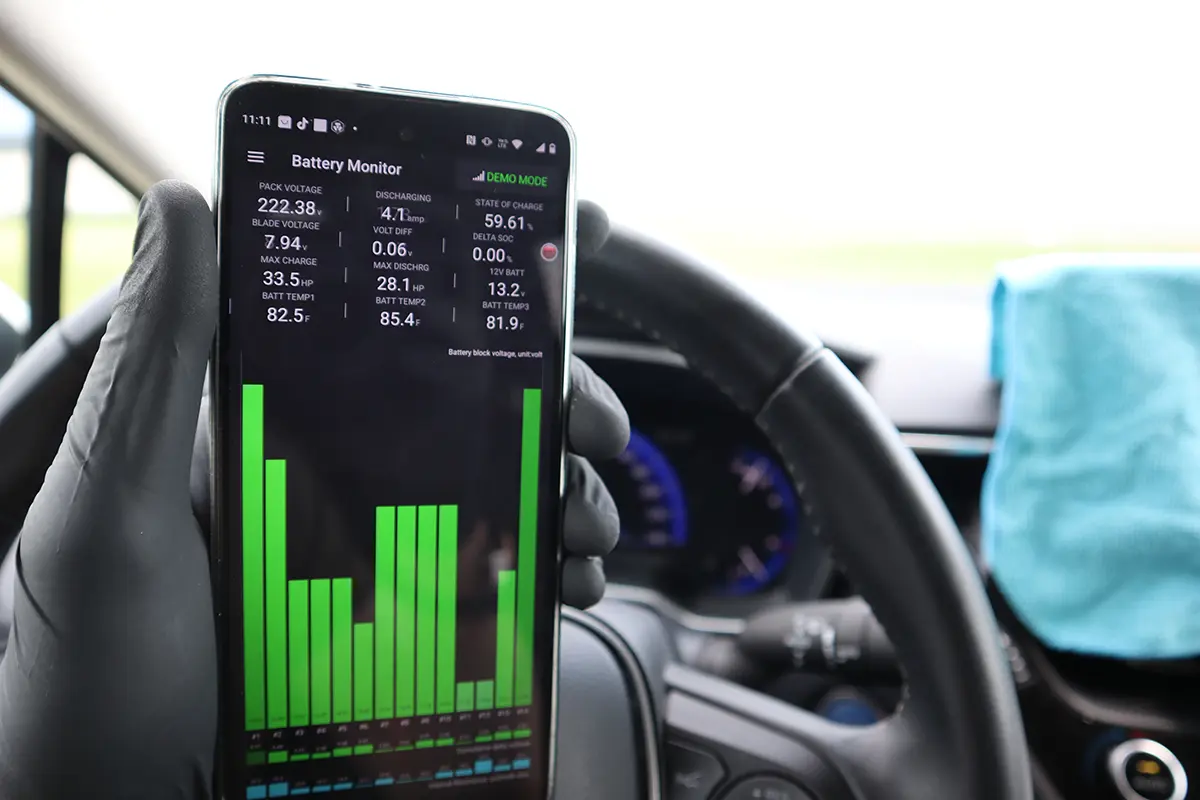
- State of health (SOH) and state of charge (SOC). Two different numbers. SOC is how full the battery is now. SOH is capacity versus new, and that’s the figure that sets an EV’s resale value.
- Cell and module voltage delta. A single SOH number can hide one weak cell. Per-cell data is often the difference between a cheap module fix and a full pack swap.
- BMS fault codes and balancing status.
- Insulation resistance and HV interlock (HVIL) status. Safety-critical. Water in an HV connector is a classic cause of a car refusing to power up.
- Contactor testing for welded or stuck contacts, a frequent “won’t go to ready” cause.
- Inverter/motor, on-board charger and DC-DC data.
- Thermal management, including ECU-driven coolant bleed routines.
- SOC = current charge level, moves every drive
- SOH = remaining capacity vs original, degrades slowly over years
The three tool tiers
The honest way to think about EV tools is by the job, not the brand.
Tier 1: DIY monitoring. An OBDLink or good ELM327 dongle plus a model-specific app.
Leaf Spy for the Nissan Leaf, Scan My Tesla for Tesla (with the right adapter), OBDeleven for VW group, CanZE for the Renault Zoe, OBD Fusion with EV PID files for Hyundai, Kia, MG and BYD, BimmerLink for BMW.
These use reverse-engineered OEM PIDs and give you SOH, cell delta and temperatures for very little money. The catch: they only work on supported models with the correct profile.
Tier 2: shop tablet plus EV kit. Autel MaxiSYS with the EVDiag Box, Launch X431 with its EV kit, XTool D9EV, Topdon’s EV kit.
These read and clear all-system codes, show SOC and SOH, do in-vehicle and offline battery-pack analysis, and run HV component tests. Strong for a general shop that sees the occasional EV.
Tier 3: OEM or dedicated. Battery and inverter surgery, module coding after a pack swap, reflashing, motor resolver calibration.
This is Tesla Toolbox and dealer-tier access territory, not aftermarket reach. Technicians who do this daily are blunt about it: multi-brand tablets are fine for chassis and body modules and some EV bi-directionals, but for battery or inverter work you bring the OEM tool.
The traps that cost people money
Don’t assume an “EV version” is just a software update. On Autel, Launch, XTool and Topdon it’s a software license plus a hardware kit: a breakout box, brand adapters and battery-pack test leads. The headline feature, offline out-of-vehicle pack analysis, is impossible without the hardware, because you’re connecting to pack connectors that aren’t the OBD port.
Don’t treat a 16-pin port as proof of coverage. Plenty of EVs have the connector but expose no standard propulsion PIDs through it. Tesla is the special case: proprietary connectors for years, a standard J1962 port only on new builds from around April 2024, and even that runs UDS over DoIP, not generic OBD2. Always check the tool’s coverage list for the exact make, model and year before you quote a job.
The most useful thing a plain scanner does on an EV has nothing to do with the traction battery. It’s watching 12V system voltage to catch a failing DC-DC converter or a weak 12V battery, which strands more EVs than any HV fault.
The protocol reality that decides everything
This is what separates a tool that works on modern EVs from one that just connects.
A current EV usually needs more than classic OBD2 CAN. It needs CAN FD (battery messages run longer than the old 8-byte limit), DoIP (Ethernet diagnostics on 2024 and newer European EVs), and UDS security access to get past gateways like VW’s SFD and FCA’s SGW.
A generic ELM327 cannot pass those gateways. No DoIP means literally no communication with the newest cars.
The Rivian R1T is the extreme example. It has an OBD2-shaped port with no CAN on it at all, only Ethernet and DoIP, and Rivian says generic adapters simply will not work.
What’s coming (and why it matters for buying)
Regulation is catching up. A new standard, SAE J1979-3 (ZEVonUDS), forces standardized access to EV data, including a standardized SOH identifier, phasing in from model year 2026 and reaching all US-market EVs by 2028.
That will make basic data like SOH readable by any compliant tool. But it only covers reading data, codes and routines, not coding or flashing.
The flip side: from model year 2027 combustion cars move to OBDonUDS too. A scanner that only speaks classic OBD2 will start losing even emissions access on new vehicles.
If you’re buying now, get a tool whose vendor has a real update track record and a stated UDS path, or you’re buying something with a shelf life.
Which route makes sense for you
- DIY owner or used-EV inspection: skip the pro tablet. A dongle plus the model-specific app gets you SOH, cell delta and temperatures, which is exactly what a purchase decision turns on.
- Independent shop, occasional EVs: a current mid or high tablet with the EV upgrade kit, plus Tesla adapters if you see Teslas.
- Doing pack or inverter work: a dedicated EV platform, paired with real HV safety gear. The scan tool is not a safety device.
I’m putting the specific tool picks into a separate roundup of the best OBD2 scanners for EVs, where the model-by-model coverage actually lives.
EV high-voltage systems run at 400 to 800V DC and will kill you. No scan-tool insulation reading replaces verifying zero potential with a properly rated meter before HV work, and HV gloves are not a suggestion. If that sentence made you uneasy, that job belongs with someone trained for it.
Can you use an OBD2 scanner on an electric car?
You can connect one to most EVs, but a generic scanner reads very little about the propulsion system. OBD2 was designed for emissions data, and EVs were never required to expose battery or motor data through those standard channels. You'll usually get generic fault codes, some basic live data and 12V system voltage. For battery health and high-voltage data you need a model-specific app or a pro tool with dedicated EV software.
Why does my scanner show nothing about my EV's battery?
Because the battery data lives behind manufacturer-specific protocols, not the generic PIDs your scanner reads. State of health, cell voltages and BMS status are not emissions data, so there was never a legal requirement to make them readable by any tool. A tool only sees them if it has EV-specific software or the correct reverse-engineered PID profile for that exact model.
Do all electric cars have an OBD2 port?
No, and even when the 16-pin connector is present it often exposes no standard propulsion data. Some EVs use proprietary connectors, and the newest ones move to Ethernet and DoIP with no usable classic OBD2 at all. Tesla only added a standard port on new builds around April 2024, and it still runs manufacturer diagnostics rather than generic OBD2.
Most popular OBD2 guides

Hi, I am Juraj Lukacko. I got frustrated by unhelpful and scammy mechanics, so I decided to learn everything about car diagnostics myself. I test dozens of new car diagnostic tools every month along with learning new strategies to fix and customize cars.