Published: February 17, 2026 · Last updated: April 28, 2026
Yes, you can fix most TPMS problems with the right scanner. But you need to know which of three operations you’re actually doing — most DIY confusion comes from mixing them up:
- Activation = waking up a sensor to read its data. Almost any TPMS tool can do this on any brand.
- Programming = writing data to a blank universal sensor. Brand-locked. Thinkcar tool programs Thinkcar sensors. Autel programs Autel.
- Relearn = telling the car which sensor is on which wheel. Three methods, depending on the manufacturer.
Quick decision tree:
- Light on, pressures correct on a gauge → Sensor problem or stale baseline. Activate each sensor, find the dead one.
- Light on after rotation or seasonal swap → Relearn needed.
- Replaced sensor, light still on → Wrong frequency (315 vs 433 MHz), wrong protocol, or relearn skipped.
- Light on but no per-wheel pressure display → Doesn’t mean indirect TPMS. Read the next section.
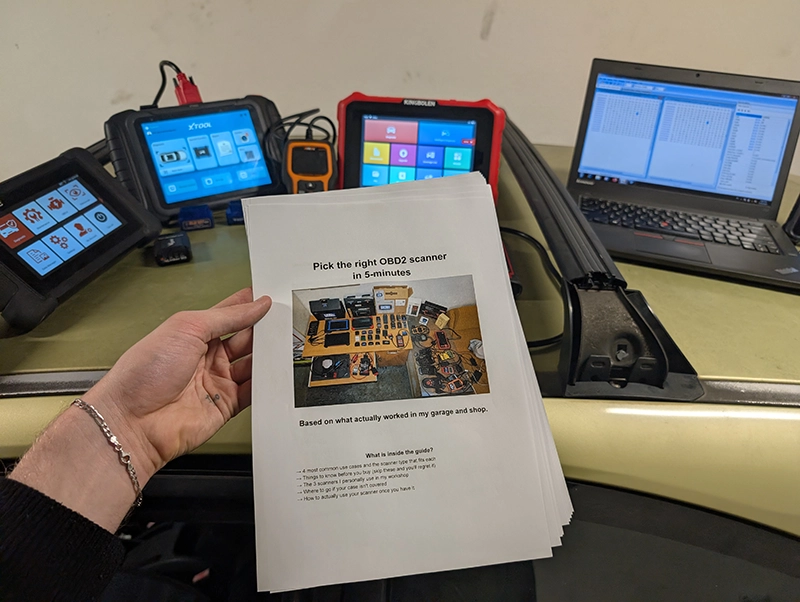
If you just want my recommended scanners: Best OBD2 Scanners for TPMS →
My Real-World TPMS Procedures
If your car matches one of these, jump straight there.
Direct vs Indirect: The Difference That Decides Everything
Two completely different systems, same dashboard light. If you don’t know which one your car has, every diagnostic step downstream is wrong.
Direct TPMS has a battery-powered radio sensor inside each wheel. Each one measures actual pressure and temperature, broadcasts a unique 4-byte ID. North America runs on 315 MHz, Europe and most of the world on 433 MHz. Battery lasts 5–7 years, and when it dies you replace the whole sensor — battery is sealed in epoxy, not user-serviceable.
Indirect TPMS has no sensors in the wheels. It uses the ABS wheel-speed sensors. A low-pressure tire has a smaller rolling radius and rotates faster than the others. The system catches the difference and flags it.
What indirect can’t do:
- Show actual pressures, only a warning lamp
- Detect a flat in the first few hundred meters of driving
- Detect simultaneous slow loss on all four (older systems)
- Work without a baseline reset after every inflation change or rotation
This is why my E61 with a flat tire showed all green when I noticed it 50 meters off the curb — RPA (indirect) needs minutes of driving above 25 km/h to see anything. Some late E60/E61 builds had RDC (direct) instead. To tell which: rubber snap-in stems = RPA, aluminum hex-nut stems = RDC. iDrive showing numerical pressures per wheel = RDC.
“Lamp Only” Doesn’t Mean Indirect
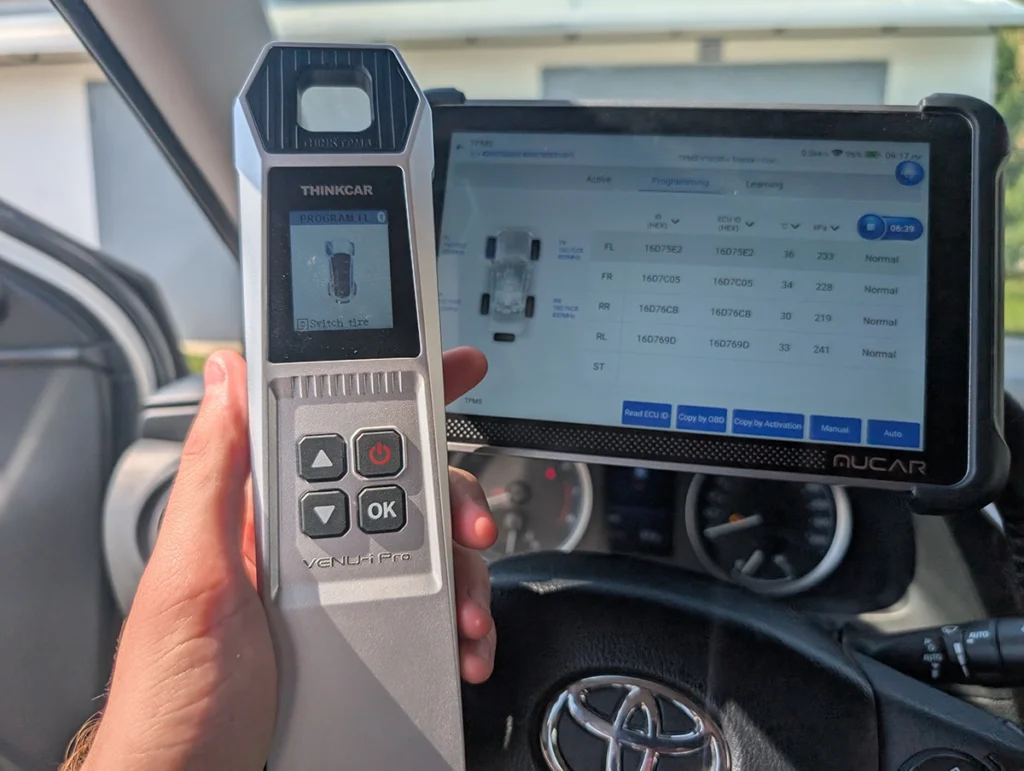
This is the trap. Plenty of Toyotas, Mazdas, Hyundais, and base-trim cars have direct sensors in every wheel but the dashboard only shows a warning lamp. Federal regs only require the warning telltale, per-wheel display is a premium-trim feature.
To tell for sure:
- Valve stems. Aluminum hex-nut = direct. Rubber snap-in = could be either.
- TPMS tool. If anything reads back a sensor ID, you have direct.
- OBD scan. Direct has a TPMS module storing sensor IDs. Indirect doesn’t.
Sensor Types
Three categories. This is where DIY budgets get blown.
- OEM (genuine). Pre-programmed at factory. Drop-in. $45–95 each at dealer. Cannot be reprogrammed.
- Pre-programmed aftermarket. Sold as “for Toyota Camry 2018–2022”. Made by Schrader, Continental/VDO, Huf, Pacific/Denso. $25–55 each. Functionally identical to OEM. Many “OEM” boxes from parts stores actually contain rebadged Schrader or VDO.
- Programmable universal. Blank sensors that emulate dozens of OEM protocols. Autel MX-Sensor, Schrader EZ-sensor, Continental REDI-Sensor, Hamaton U-Pro, Thinkcar Venu5. $15–35 each + a compatible programming tool.
- The brand-locking trap: Autel, Thinkcar, Launch, and Xtool tools program only their own brand of universal sensor. Schrader EZ, Continental REDI, and Hamaton U-Pro are programmable by most major shop tools (Bartec, ATEQ, Snap-on) but not by the proprietary brand-locked tools. Match the sensor to the tool ecosystem.
What “Activation” Actually Means
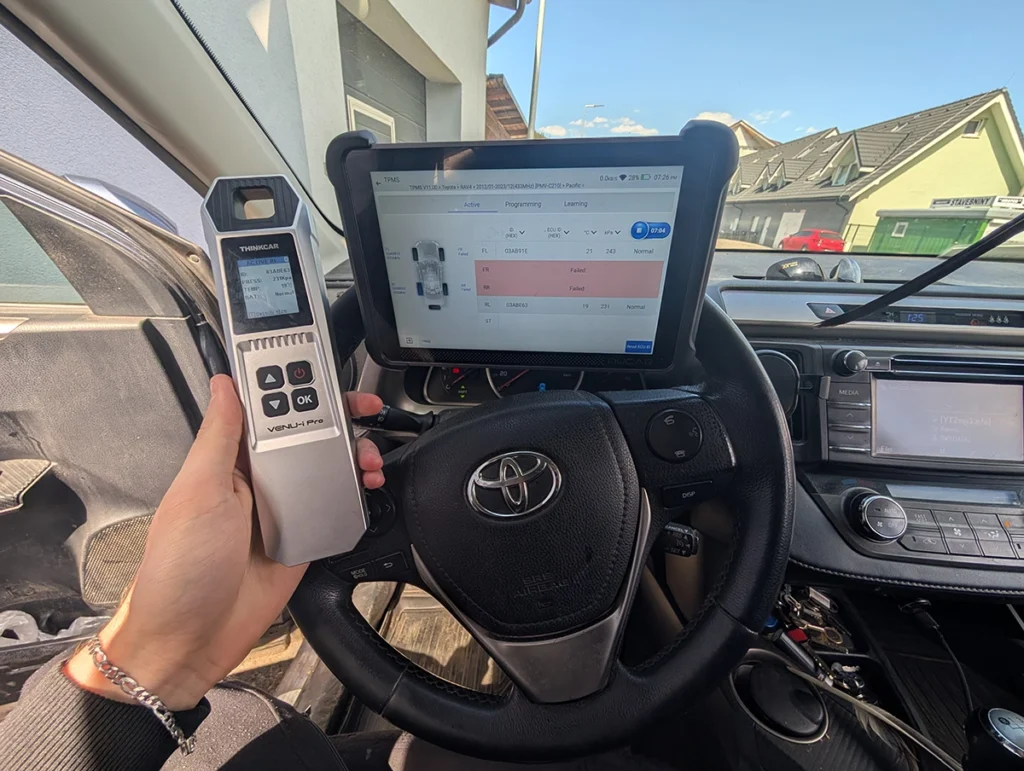
This was my own confusion when my mate’s RAV4 came in. Two sensors didn’t respond to my Thinkcar Venu 90, two did. Dead sensors, replace. Forums were saying TPMS tools only work with their own brand sensors — so will Thinkcar even activate genuine Toyota OEM sensors?
The forums are half-wrong. Here’s what’s actually happening:
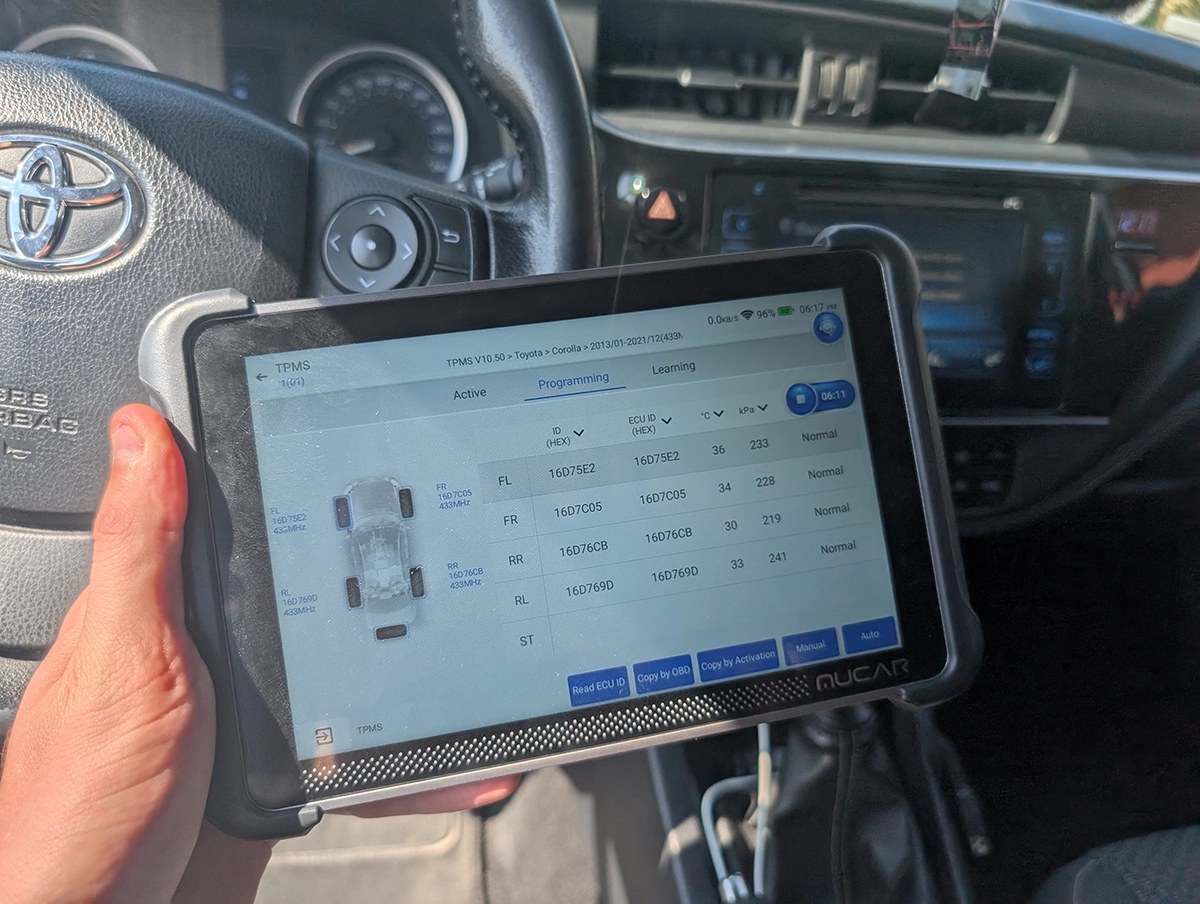
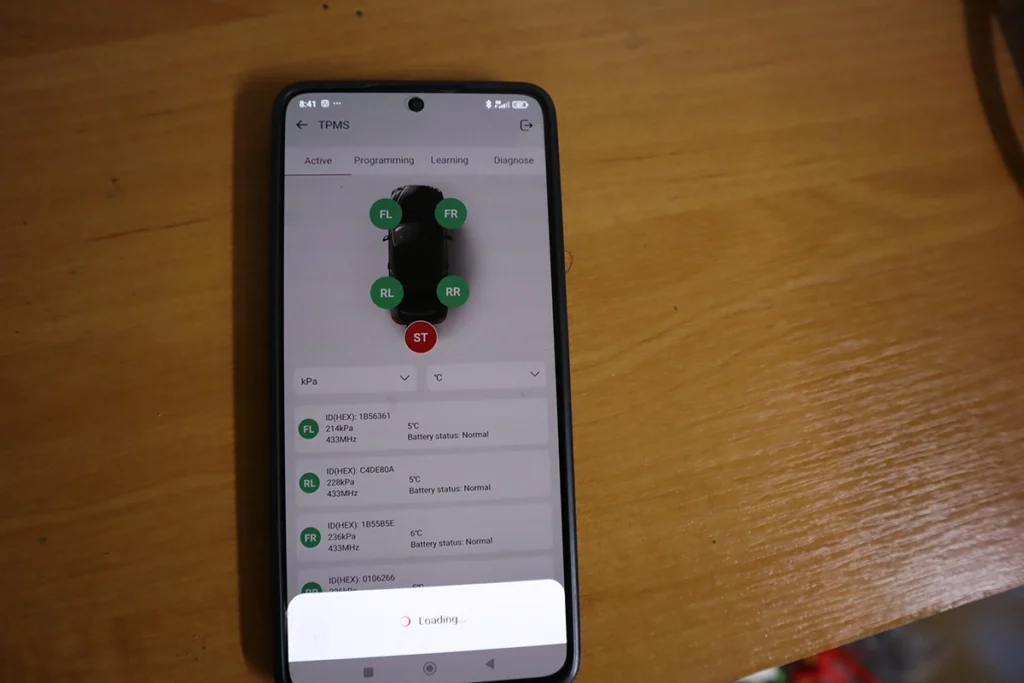
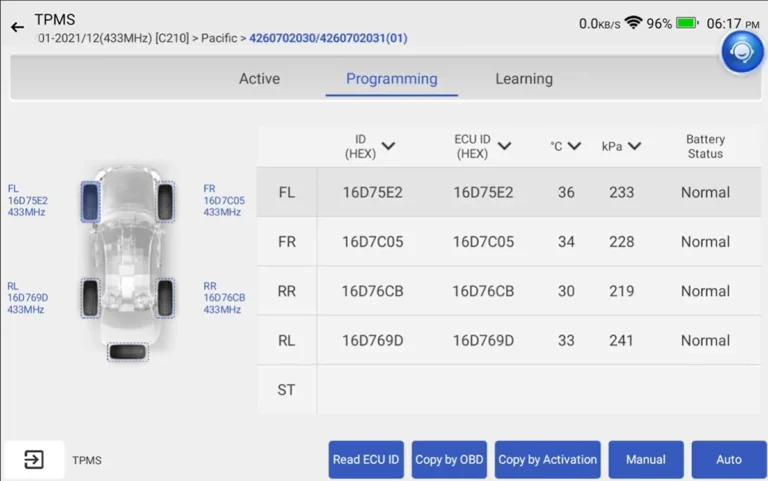
Activation is a read operation. Tool sends a 125 kHz wake-up pulse, sensor broadcasts its ID, pressure, temp, battery on UHF. Tool listens and shows the data. Nothing is being written to the sensor. Works on virtually any sensor regardless of brand.
Programming is the write operation, and that’s what’s brand-locked. Writing a sensor ID and protocol firmware into a blank universal. Autel programs Autel MX. Thinkcar programs Thinkcar. Closed ecosystems.
So for the RAV4: genuine Toyota PMV-C015 → drop in, Thinkcar activates fine, OBD relearn, done. Or Thinkcar Venu5 sensors → program with Thinkcar, install, OBD relearn, done. Don’t buy Autel MX or Schrader EZ for a Thinkcar tool — it can’t program them.
The Three Relearn Methods
Once a fresh sensor is in the wheel, the car has to know about it.
Auto-relearn (drive and go). Inflate to placard, ignition off, wait 15–20 minutes, drive 10 minutes above 25 km/h. Car listens for sensor broadcasts and auto-registers them. Used by Mazda 2/3/5/6/CX-7/CX-9 (most years), some Hyundai/Kia, some VW, many Mitsubishi.
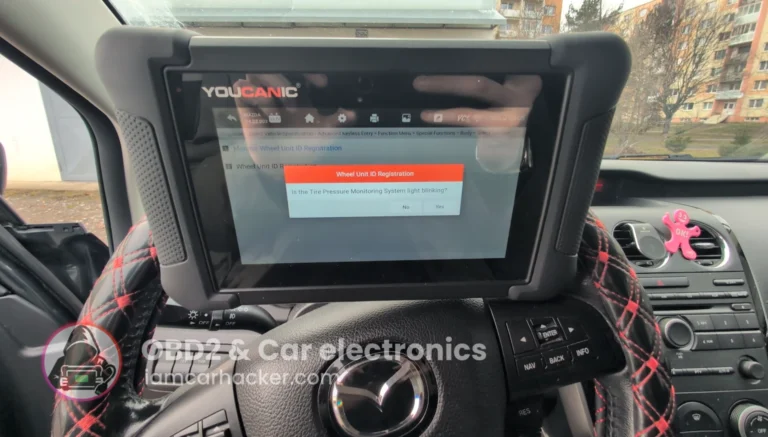
This is why my Mazda CX-7 relearn was weirdly easy. Scanner did something for a few seconds, said “done”, light went out — no ID writing happened, the scanner just kicked off the auto-learn timer. Mazda’s design lets the ECU find sensors on its own. Toyota’s doesn’t.
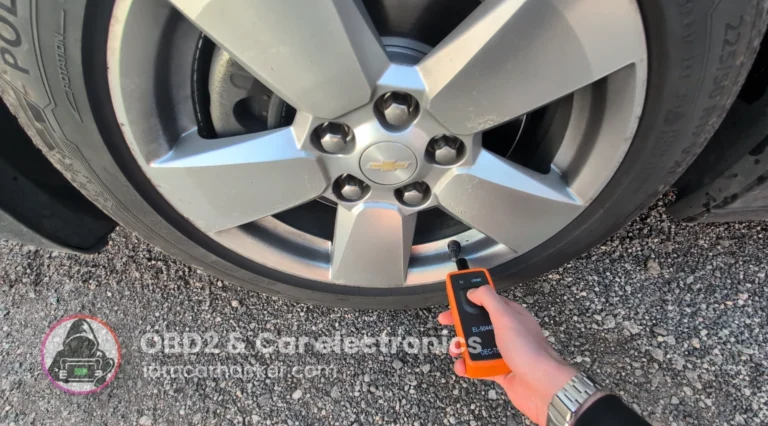
Stationary relearn. Specific key/button cycle puts the car in learn mode, each wheel triggered in order (LF → RF → RR → LR) with a TPMS tool or magnet. Older Ford (2007–2017), older Chrysler/Dodge/Jeep, GM 2003–2007, older Nissan/Infiniti.
OBD relearn (write IDs to ECU). Tool activates each sensor to capture IDs, plugs into OBD, writes them to the TPMS module. Most modern Toyota, Lexus, Honda, Acura, BMW (F/G with RDC), Mercedes, Volvo, VAG (post-MQB), GM 2014+, newer Ford with Sync ID.
If you don’t know which method your car uses, OBD relearn is the safe default. A tool that supports OBD relearn (Thinkcar Venu 90, Autel TS508, Foxwell GT75TS, Bartec) covers virtually everything.
Diagnosing TPMS Problems
Step 1: Always check pressures with a gauge first. More than half of TPMS warnings in cold weather are valid — 1 psi drop per 6 °C ambient drop adds up fast. Don’t assume system fault when the system is telling the truth.
Step 2: If pressures are correct but light persists, run through this:
| Scenario | Likely cause | Fix |
|---|---|---|
| All sensors respond, IDs match ECU, pressures correct | Stale baseline, recent rotation | Relearn |
| One sensor doesn’t respond | Dead battery, broken sensor, or wrong frequency | Replace, relearn |
| Sensor responds with low-battery flag | Near end of life | Replace soon |
| ECU shows different ID at that wheel | Recent rotation without relearn | OBD relearn |
| Correct pressures reported but light stays on | Module fault, antenna, CAN comms | Scan for U-codes, check fuses |
| Flashing TPMS at startup, then solid | Classic dead-sensor signature | Activate each, find the silent one |
Step 3: For indirect TPMS there are no sensors to test. Confirm placard pressures, confirm tire size matches across axles, scan ABS for wheel-speed faults, reset baseline (button, iDrive, MFA, or VCDS adaptation), drive 15–60 minutes mixed conditions.
Common Fault Codes
Toyota / Lexus
- C2121–C2124 → No sensor ID at FL/FR/RR/RL
- C2126 → Low pressure detected
- C2171 → Sensor IDs not registered
BMW (RDC/RPA)
- 0x3D → Wheel electronics: no reception
- 0x29 → Tire pressure control fault stored
- 5DF0–5DF8 → RDC module fault sub-codes
Ford
- B2868–B2872 → Specific wheel sensor missing/no signal
- C1A56:51 / C1A58:51 → Sensor not programmed
VAG
- 01316 → TPMS warning lamp fault
- 02049 → Tire pressure sensor failure
When Replacing Sensors
| Strategy | Cost (4 sensors) | Best for |
|---|---|---|
| Genuine OEM at dealer | $160–600 | Single-vehicle owner, peace of mind |
| Pre-programmed aftermarket | $100–240 | Most DIY — best value |
| Programmable universal, same brand as tool | $60–140 + tool | DIY with multiple cars |
| Cloned universal | $60–140 + tool | Quickest install if old sensor still readable |
Common DIY mistakes:
- Buying an Autel MX 4-pack on Amazon and a cheap eBay tool that can’t program Autel. Sensors unusable.
- 315 MHz sensor for a European 433 MHz car. Installs fine, never communicates.
- No-name Chinese sensors with no documented protocol.
- Pinching the original sensor between bead and rim during DIY tire mount. Always position the sensor 90° from where the bead-breaker contacts.
Tire Shop Damage to Watch For
- Sensor pinched between bead and rim during dismount → replace, no repair option
- Aluminum stem corrosion in road-salt environments → replace grommets every seasonal swap
- Wrong cap material on aluminum stems (plastic instead of brass-and-rubber) → galvanic corrosion seizes cap to stem
- Tire sealants → prohibited on TPMS tires, clogs the pressure port
- Over-torqued aluminum stem nut → 4 N·m / 35 in-lbs, that’s it
High-volume tire chains damage sensors at a higher rate than independent shops because of fast cycle rates. Ask the tech to orient the sensor 180° from where the bead breaker contacts.
FAQ
Can any OBD2 scanner do TPMS? No. Generic scanners read codes only. You need a TPMS-capable tool with sensor activation, OBD relearn, and ideally programming. Most under $80 won’t.
Why doesn’t my dashboard show pressures even though I have sensors? Federal regs only require a warning telltale, not numerical display. Many Toyota, Mazda, and Hyundai base trims have full direct TPMS but no per-wheel readout.
Will OEM sensors work with an aftermarket tool? For activation and OBD relearn, yes — virtually any modern tool reads OEM sensors. For programming a blank universal, only the matching brand’s tool.
How long do TPMS sensor batteries last? 5–7 years for daily drivers, 4–5 for high mileage, up to 10 for low-mileage cars. Battery is sealed and non-replaceable.
Is my BMW E61 RPA or RDC? Rubber snap-in stems = RPA. Aluminum hex-nut = RDC. iDrive numerical pressures = RDC, just a reset button = RPA. SA option 2VB on the build sheet = RDC factory-fitted.
What’s the difference between activation and programming? Activation reads data from a sensor (works across brands). Programming writes data into a blank universal (brand-locked).
The Bottom Line
TPMS is three things, not one. Direct vs indirect. Activation vs programming vs relearn. OEM vs pre-programmed aftermarket vs programmable universal.
Most DIY problems come from mixing those up — buying a sensor incompatible with the tool, assuming “lamp only” means indirect, skipping a relearn after rotation, or trying to fix a $30 sensor problem the wrong way.
When the light is on: pressure gauge first, scanner second. Match the sensor to the tool, and the relearn step is usually 5 minutes once you know which method your car uses.
If you’ve got a question I didn’t cover, hit the contact page or drop a comment. I read everything.
→ Best OBD2 Scanners for TPMS in 2026
Hi, I am Juraj Lukacko. I got frustrated by unhelpful and scammy mechanics, so I decided to learn everything about car diagnostics myself. I test dozens of new car diagnostic tools every month along with learning new strategies to fix and customize cars.