Published: March 18, 2026 · Last updated: July 7, 2026
You don’t need expensive tools to check a catalytic converter. A basic OBD2 scanner that shows live data as a graph is enough.
The whole test comes down to one idea: compare the oxygen sensor before the cat against the one after it. This is the method I use in real diagnostics.
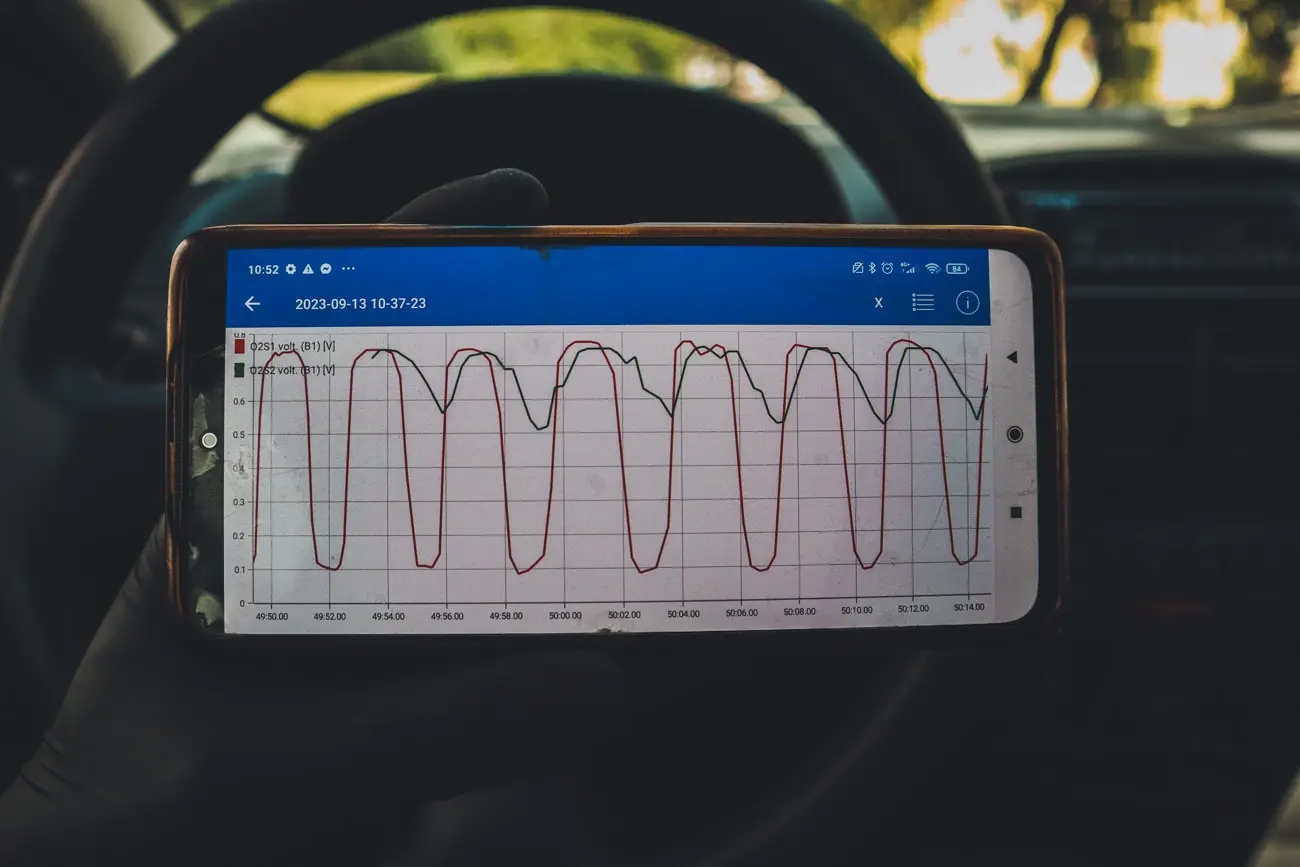
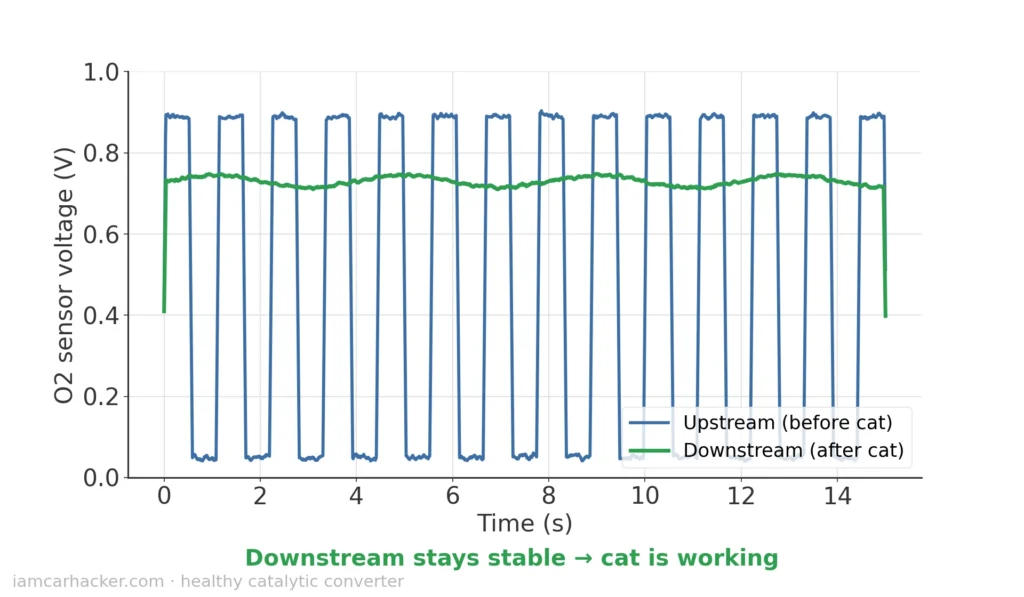
A working cat cleans up the exhaust, so the downstream O2 sensor should sit calm and steady while the upstream one swings up and down. When the downstream sensor starts copying the upstream one, the cat is done.
VIDEO: How to test catalytic convertor by looking at live data
This content is for members only.
How the O2 sensor test works
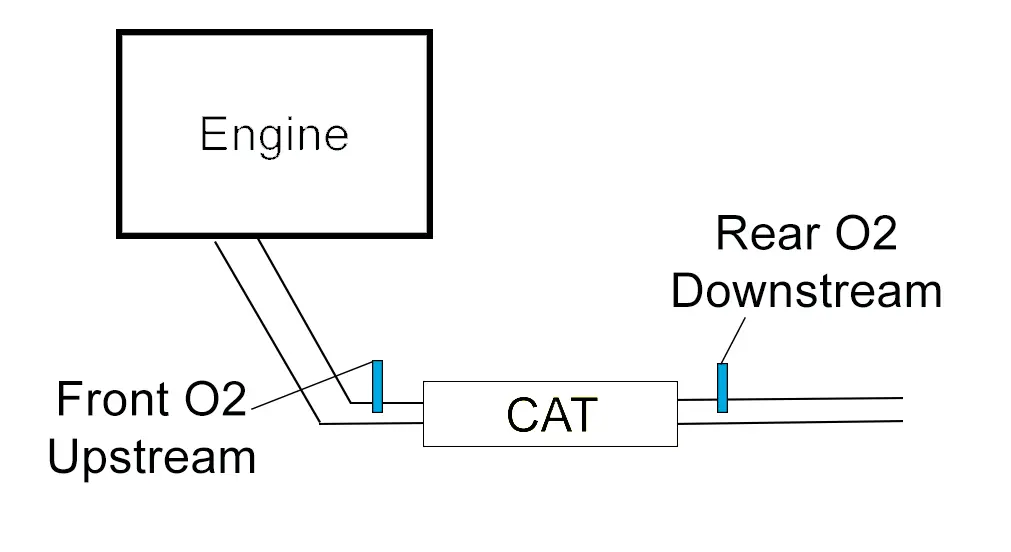
Petrol cars have two oxygen sensors around the cat. The upstream sensor (sensor 1) sits before the cat. It constantly switches rich and lean, so it swings up and down all the time.
The downstream sensor (sensor 2) sits after the cat. On a healthy cat it holds a fairly stable voltage.
If both sensors swing the same way, the cat isn’t doing its job.
Test the downstream sensor first
Here’s the step almost every guide skips, and it’s the one that matters most.
A dead downstream O2 sensor looks exactly like a dead cat on the graph. A flat downstream line could mean a perfect cat, or a lazy sensor that can’t move. You can’t tell which until you prove the sensor works.
Don’t condemn a cat off a flat downstream line before you’ve confirmed the downstream sensor is alive. A lazy or dead sensor gives you a false “bad cat” reading, and you replace an expensive part for nothing.
So start with a snap test on the rear sensor.
- Warm the engine to full operating temperature.
- Driving at around 1500 to 2000 RPM, go full throttle for about 2 seconds.
- Lift off completely and let the engine brake.
A healthy downstream sensor swings the full range: up near 0.9V under acceleration, down close to 0V on the overrun.
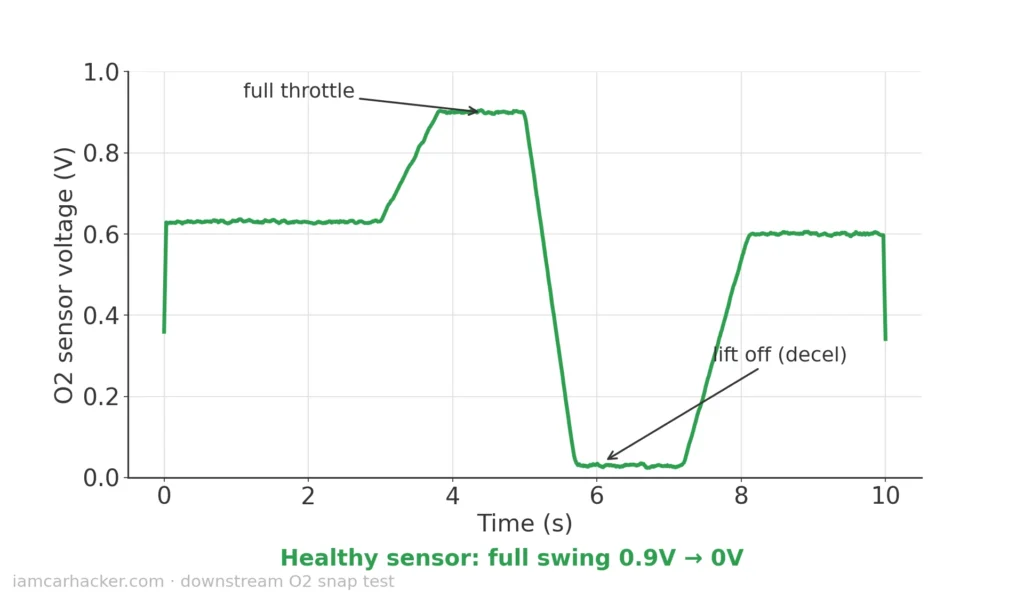
f it barely moves, the sensor is your problem, not the cat. Fix that first, then come back to the cat test.
Load test the catalytic converter
Once the rear sensor is proven good, test the cat under load.
Watch the upstream and downstream sensors together on the graph. Hold around 50% throttle for 10 to 15 seconds.
On a good cat, the upstream sensor keeps oscillating while the downstream stays stable, roughly 0.7 to 0.9V.
Confirm under higher load
Repeat the test at 60 to 70% throttle and keep your eyes on the downstream line.
If it stays flat and calm, the cat is healthy. If the downstream sensor starts jumping and mirroring the upstream one, the cat is failing.
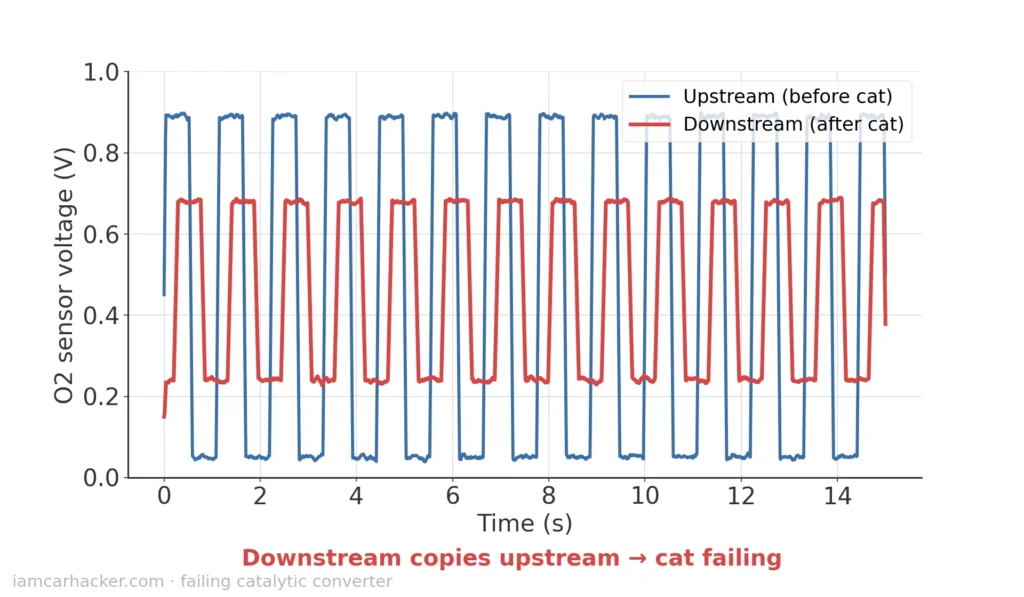
The tell is timing. A tired cat lets the downstream sensor slowly start copying the upstream trace under load. If the two lines look identical under every condition, even at idle, the cat is likely gutted or empty inside.
What a bad cat looks like
- No real difference between the two sensor traces.
- Similar values even at idle.
- Downstream swings almost as hard as upstream.
That usually means the cat is worn out or the honeycomb inside has collapsed.
What you need for this test
Any scanner that shows live O2 sensor data as a graph will do this. The graph is the point. You’re reading the shape of the trace over time, not a single number, so a tool with a live data graph view makes this far easier than watching digits scroll past.
This is also a petrol test. Diesels don’t run the same switching O2 sensor setup, so this exact method doesn’t transfer to them.
Can you test a catalytic converter with an OBD2 scanner?
Yes, on a petrol car. You compare the upstream oxygen sensor (before the cat) with the downstream one (after it) in live data. A healthy cat keeps the downstream sensor stable while the upstream one keeps switching. When the downstream sensor starts copying the upstream, the cat is failing. You need a scanner that shows O2 sensor data as a graph, but it doesn't have to be expensive.
How can you tell a catalytic converter is bad from live data?
On a good cat, the downstream O2 sensor holds a fairly steady voltage around 0.7 to 0.9V while the upstream sensor swings rich and lean. On a bad cat, the downstream sensor starts swinging too and begins to mirror the upstream trace. If both sensors read almost identically under load and even at idle, the cat is likely gutted or worn out.
Can a bad oxygen sensor look like a bad catalytic converter?
Yes, and it's the most common mistake with this test. A lazy or dead downstream sensor gives a flat, unresponsive line that can read as either a healthy cat or a completely dead one depending on how you look at it. That's why proving the downstream sensor can still swing its full range comes before any conclusion about the cat.
Most popular OBD2 guides



Hi, I am Juraj Lukacko. I got frustrated by unhelpful and scammy mechanics, so I decided to learn everything about car diagnostics myself. I test dozens of new car diagnostic tools every month along with learning new strategies to fix and customize cars.