Published: March 18, 2026 · Last updated: June 28, 2026
The fastest turbo check costs nothing if you already own a scanner with live data. You compare two numbers the car gives you: what the ECU is asking the turbo for, and what the turbo actually delivers. If they match, the turbo is doing its job. If a gap opens up under load, you have a problem.
This is the quickest real-world turbo check you can do without taking anything apart.
Quick answer
Open live data, find specified boost (what the ECU wants) and actual boost (what the turbo makes), graph both, and drive. Match means healthy. A growing gap under acceleration means the turbo isn’t delivering.
If they match → turbo is working
If they don’t → you have a problem
A turbo test on a scanner is one comparison: specified boost versus actual boost, under load. Tracks closely means healthy. Falls short means a boost problem worth chasing.
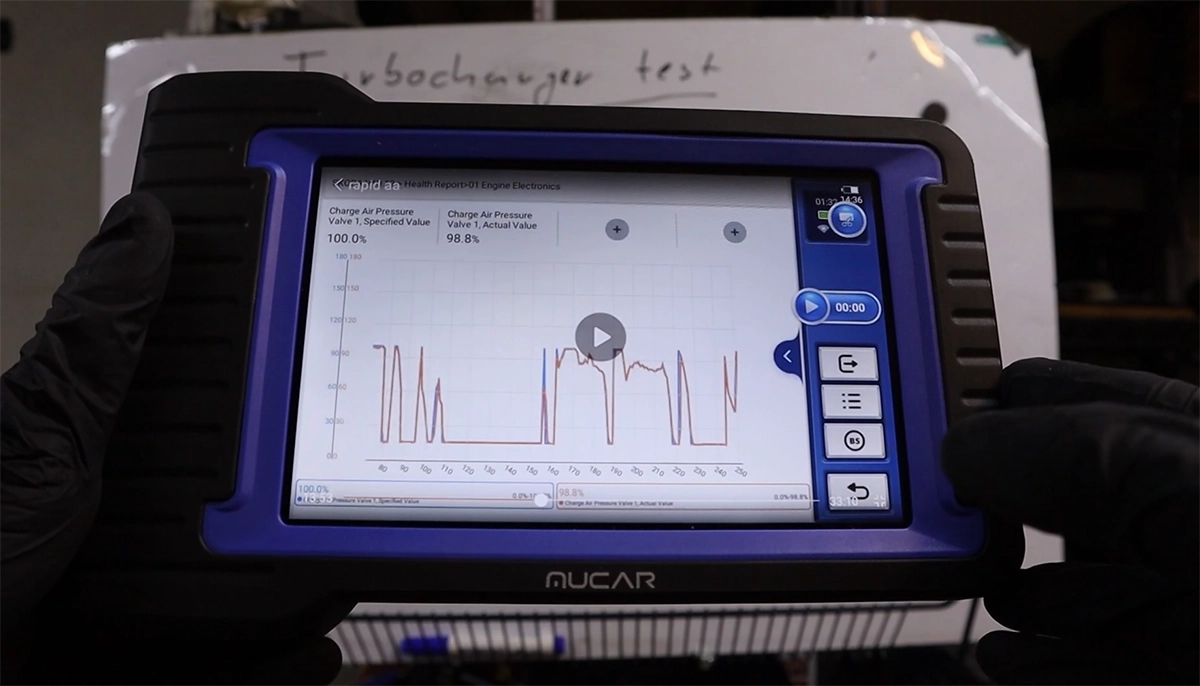
Video: How to test turbocharger with OBD2 scanner
This video shows the exact process and real driving test using live data.
This content is for members only.
What you need
A scanner that shows live engine data. Graphing makes this test, watching two lines is far clearer than two jumping numbers. You don’t strictly need a bidirectional tool here, but the ones that graph live data well are usually the bidirectional ones.
You also need to reach the engine module and pull both boost parameters at once.
What values to look for
You want two parameters. The names vary between cars and scanners, so look for these:
| Value | What it means |
|---|---|
| Specified / target boost | What the ECU is requesting |
| Actual / measured boost | What the turbo is producing |
Common names you’ll see on the list: charge air pressure, boost pressure, intake manifold pressure. Some cars label them in kPa absolute, some in bar or mbar. The units don’t matter for this test, only whether the two values track each other.
Step-by-step turbo test
Connect the scanner, go to the engine module, open live data, and find both boost values. Display them together, ideally on one graph. Then test in two phases.
1. Idle check. A small difference at idle is normal, and actual can even sit slightly above specified. Ignore it. Idle tells you almost nothing about a turbo.
2. Driving test. This is the real one. Do a few firm accelerations and watch how the two lines behave as the revs climb. A turbo only shows its weakness under load.
Do the pulls safely, ideally a passenger watches the screen or you log the data and read it after. The fault shows up during hard acceleration, not while you’re parked staring at the tool.
How to read the graph
On a healthy turbo, actual boost follows specified closely on every pull. There’s a small lag as the turbo spools, then it catches the target and holds it.
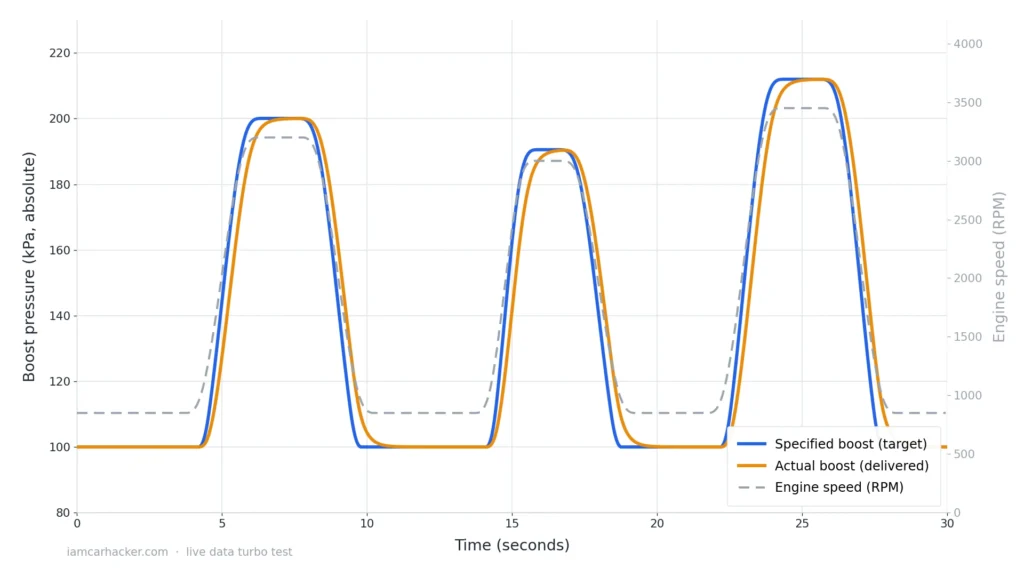
Healthy turbo. Actual boost (orange) tracks the specified target (blue) on each pull. The small spool-up lag closes quickly and the turbo holds the target.
On a failing turbo, the lines split. Specified climbs as you accelerate, but actual builds slowly and never reaches it. The gap that opens up under load is the symptom.
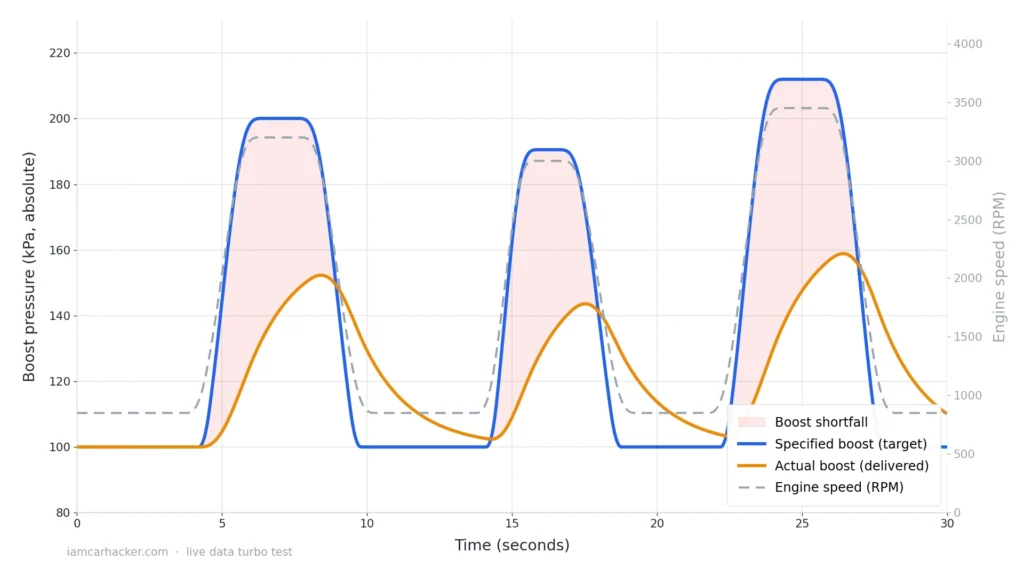
Failing turbo. Same target, but actual boost builds slowly and tops out well below it. The shaded area is the boost shortfall, and it grows exactly when you ask the turbo to work.
What a boost shortfall usually means
Here’s the honest limit of this test: it tells you the turbo isn’t making target boost. It does not tell you which part is at fault. A shortfall like the one above is usually one of these:
- Boost leak (split hose, loose clamp, cracked intercooler or pipe)
- Faulty turbo actuator or wastegate
- Vacuum or control issue
- A genuinely worn or failing turbo
So treat the graph as confirmation that something is wrong, then chase the cause. Most of the time it’s a leak or actuator, not the turbo itself, and that’s the cheap end to check first.
Don’t condemn a turbo off idle numbers, and don’t replace the turbo just because boost is low. A split boost hose makes the exact same graph as a dead turbo. Pressure-test the pipework and check the actuator before you spend turbo money.
When to use this test
It’s at its best in three situations: checking a used car before you buy, diagnosing a car that feels down on power, and verifying a turbo or boost repair actually worked. In all three you get a clear yes or no in one short drive.
The tool I use for this
Any full-system scanner with live-data graphing handles this. I run it on my Mucar 892BT, but you don’t need a 500 euro tablet for it.
A budget bidirectional scanner with a clean live-data graph does the same job, and the XTool A30M is the cheap one I’d point most people to for live-data work like this.

Common questions about reading car fault codes (DTCs)
Can you read fault codes without a scanner?
On most modern cars, no. A few older models had key-dance or pedal tricks to flash codes on the dashboard, but they're model-specific and limited to a handful of engine codes. For anything useful, and for any non-engine module, you need a scanner.
Does a fault code tell you exactly which part is broken?
No, and this is the most expensive misunderstanding in DIY diagnostics. A code names a system and a symptom, and the same code can be caused by several different faults. Always confirm with freeze frame, live data, bidirectional tests or electrical testing before replacing a part.
What does a fault code actually mean?
It's a five-character code such as P0420. The first letter is the system (P powertrain, B body, C chassis, U network), and the digits narrow it down to a subsystem and a specific fault. The code identifies the system and the type of problem, not the exact part that needs replacing.
How do you read car fault codes?
Plug an OBD2 scanner into the diagnostic port (usually under the dashboard), turn the ignition on, let the tool identify the car, and run a scan. A full-system scanner reads codes from every module; a basic engine reader or ELM327 only reads the engine. Each code that appears tells you which system flagged a fault.
Most popular OBD2 guides



Hi, I am Juraj Lukacko. I got frustrated by unhelpful and scammy mechanics, so I decided to learn everything about car diagnostics myself. I test dozens of new car diagnostic tools every month along with learning new strategies to fix and customize cars.