
Published: March 8, 2026 · Last updated: May 1, 2026
If you’ve got a car from roughly 2010 onwards, the rear brakes probably have an electric motor on each caliper instead of a regular handbrake cable. That changes how you do a rear brake job. Push the piston back with a wind-back tool and you’ll strip the gears or jam the spindle. You need a scanner to put the system into service mode first.
Here’s what works, what doesn’t, and a few weird situations I’ve run into.
For tool recommendations: Best OBD2 scanners for EPB reset
Why service mode
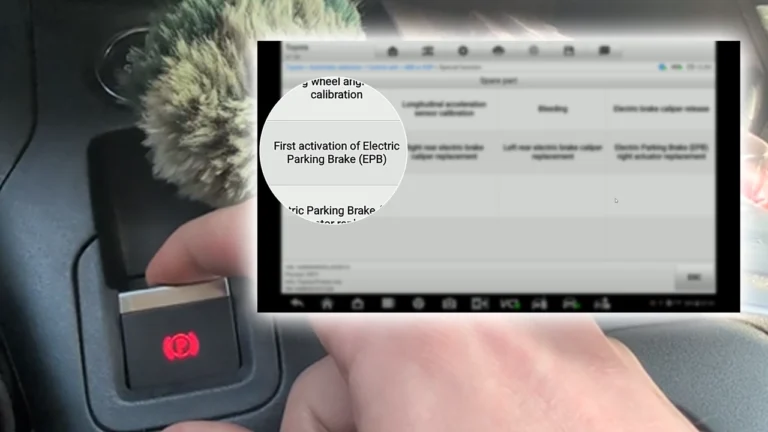
The motor on the back of the caliper drives a spindle that pushes the piston against the pads. To make room for thicker new pads, you need to retract the spindle. The only safe way is to tell the EPB module to do it through the scanner. After you fit the new pads, you run the close function so the system relearns the new pad thickness.
Skip this and you’ll end up with stripped gears, fault codes, or pads that don’t clamp properly.
The procedure (works on almost any car)
- Park, ignition on, engine off, gear in P
- Hook up a battery maintainer (this matters more than you think)
- Connect scanner, open the parking brake module, read codes
- Make sure parking brake is released
- Run service mode / open calipers. You’ll hear motors whir for about 10 seconds
- Wait 30 seconds before doing anything else
- Change the pads. Push the piston straight in with a compression tool, no rotation
- Reassemble, run close service mode
- Pump the brake pedal hard 5-10 times before driving
- Cycle the parking brake button a few times to confirm it works
Brand-specific menus differ but the order is always the same.
What I’ve learned doing this on different cars
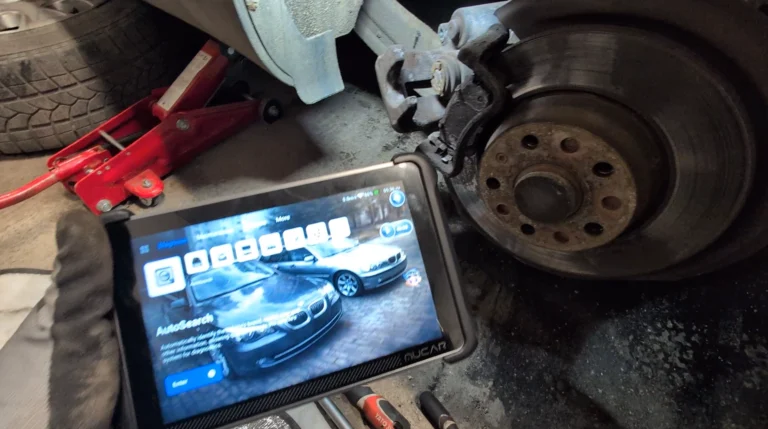
Toyota Corolla 2012. Easiest car I’ve done. Plug in scanner, open, swap, close, drive. If you want to test whether your scanner can do EPB at all, find a Corolla.
Honda Civic 2017. Took us forever. Scanner refused to enter service mode no matter what. Different tools, fresh battery, doors closed, all the usual checks. Finally cycled the parking brake button with the brake pedal pressed, dropped the car off the jack stands, and it worked first try.
What’s happening: the Civic checks wheel speed sensors before letting you in. With a wheel free to spin on a jack stand, it might read motion when you bump the wheel and reject the command. Drop it on the ground and it works. Useful trick to remember.
VW Passat B6. I did the brake job once with the Mucar 892BT, no problems. After that I played around with open/close a few times and now the EPB won’t enter service mode on any scanner I throw at it. The button left of the gauges blinks red, cluster says “conditions not met.” Brakes work fine, parking brake works fine. Just stuck in a soft fault state.
The B6 is famous for this. In order of how often it’s the actual cause:
- Weak battery (the B6 module is unusually picky)
- EPB switch failure (3C0 927 225, contacts oxidize, around 50€ to swap)
- Connector corrosion at the EPB ECU under the rear seat
- Old caliper motor (pre-2008 had cracked housing problems)
- Outdated module software (needs a dealer flash)
Common fix that often clears the soft lock: disconnect negative battery for 10 minutes. Reconnect, key on (don’t start), hold the brake pedal for 35 seconds, then while still on the brake hold the EPB switch up for 10 seconds. Works on most B6s. Not in any official VW manual but enough people in Passat forums have confirmed it.
I’m still chasing this one on my own car. Will write it up properly when I crack it.
Toyota Proace. Looks like a Toyota but it’s a Stellantis van underneath, same as the Citroën Jumpy and Peugeot Expert. The Mucar 892BT couldn’t complete service mode on it. Switched to the Autel IM608 and it worked first time.
Lesson: “broad coverage” isn’t the same as “covers PSA properly.” If you’ve got a Peugeot, Citroën, DS, Vauxhall (post-2019), Toyota Proace, Fiat Scudo, or Jeep Renegade, check your scanner’s PSA support before trusting it.
The power probe trick (and why it confused me)
On the Passat, to see if it works, I tried to retract the calipers manually with a power probe. Disconnected the EPB connector at the caliper, put the meter on both wires, and got 1-2 V on each one. I expected one to show 12 V and the other to read close to 0 (like a normal motor circuit). Both sat at the same low voltage.
Here’s why: the EPB motor doesn’t work like a normal 12V circuit with a hot wire and a ground wire. The control unit drives it through what’s called an H-bridge, which lets it flip the polarity in either direction so the motor can spin both ways (apply and release). When the motor isn’t being commanded, both wires sit at a similar low voltage from the module’s monitoring circuit. Your meter reads that bias and shows 1-2 V on both sides. Not a fault, just how it works.
So you can’t tell which wire does what by probing at rest. Two options:
- Command the motor through the scanner and watch which wire goes hot, or
- Disconnect the connector at the caliper and apply external 12V from a battery or power probe. If the motor turns and the spindle backs off, you got the polarity right. If it tries to extend further, swap the leads.
A few rules:
- Use a 10-15 A inline fuse
- Always disconnect the connector at the caliper before applying external power (don’t back-feed into the module)
- Cut power the second the motor stops (more than a second past end-of-travel and you’ll strip the gearbox)
Works on most cars as a backup. Not a replacement for a proper scanner.
The 3 things that catch people out
Almost every “conditions not met” failure comes down to one of these:
- Battery voltage below 12.5V at the terminals. Not at the jump points, the actual posts. Use a maintainer, charge the battery, replace if old.
- Scanner doesn’t have proper coverage for the brand. Especially PSA / Stellantis vehicles.
- Module is in a soft fault state. Needs power-cycling or the brand-specific reset trick.
Most popular OBD2 guides



Hi, I am Juraj Lukacko. I got frustrated by unhelpful and scammy mechanics, so I decided to learn everything about car diagnostics myself. I test dozens of new car diagnostic tools every month along with learning new strategies to fix and customize cars.