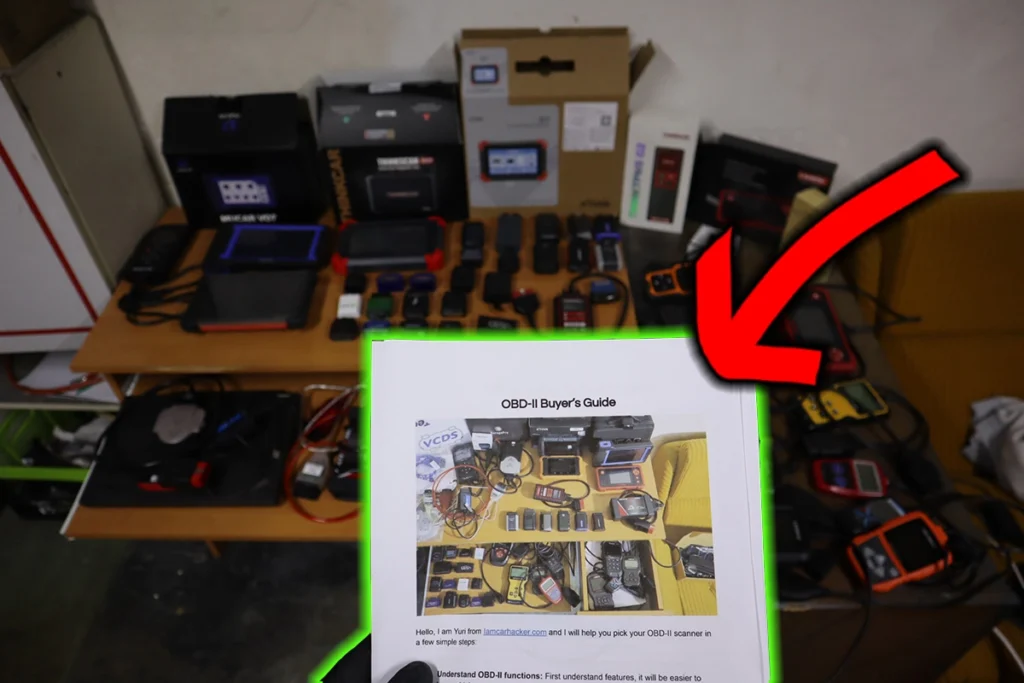
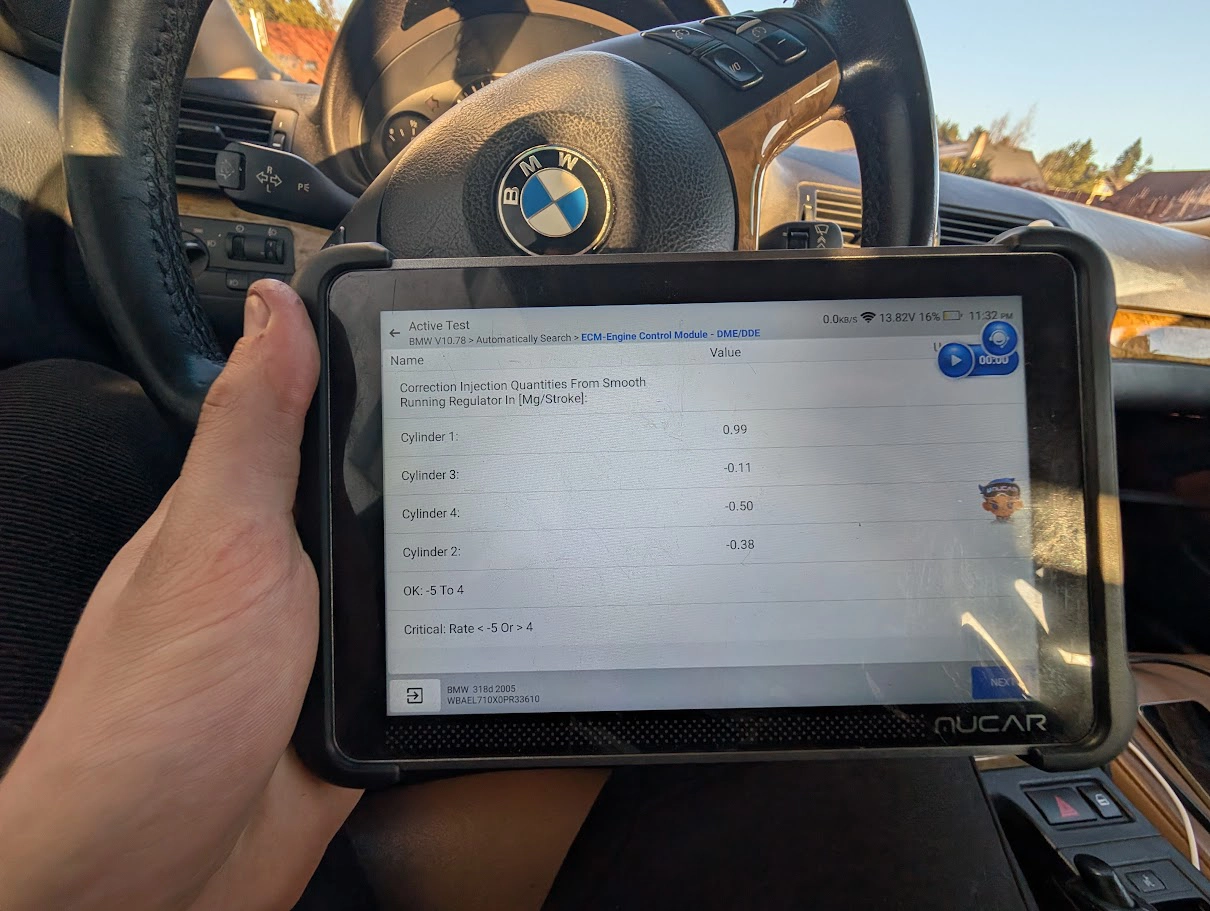
Fuel injectors can be checked with an OBD2 scanner by looking at live data such as injector balance, injection quantity, fuel trims, oxygen sensor behavior, and overall engine smoothness. This is one of the quickest ways to spot fueling problems without removing any parts.
However, abnormal values do not always mean the injectors themselves are bad. In many cases, the ECU is only compensating for another problem such as low compression, vacuum leaks, incorrect air measurement, EGR issues, or fuel pressure problems. That is why injector-related data should always be interpreted in context.
What you can check with an OBD2 scanner
Depending on the vehicle, engine type, and scan tool, you may be able to monitor:
- injector deviation / cylinder balance
- injection quantity
- injection timing
- short term fuel trim (STFT)
- long term fuel trim (LTFT)
- oxygen sensor behavior
- engine smooth running values
- misfire counters
Some advanced scanners display these parameters by name, while others require selecting measuring blocks or channels manually.
Why bad values do not always mean bad injectors
This is the most important thing to understand.
The engine control module constantly adjusts fueling to keep the engine running as smoothly as possible. Because of that, high corrections or unusual injector values can simply mean the ECU is trying to compensate for another fault.
For example, rough idle with large injector corrections does not automatically mean the injectors are faulty. The real cause may be:
- compression imbalance
- vacuum leak
- airflow meter issue
- EGR problem
- fuel pressure problem
- timing-related issue
This is why it is important to compare values at idle and under load instead of making conclusions from one screenshot.
Basic live data that helps when checking injectors
| Parameter | What it shows | What unusual values may mean |
|---|---|---|
| Injector deviation / balance | How much the ECU is correcting each cylinder | Possible injector issue, compression problem, or uneven combustion |
| Injection quantity | Amount of fuel being commanded | May point to fueling imbalance or compensation for another issue |
| Injection timing | When fuel is injected | Can help reveal timing or control issues |
| STFT | Short-term fuel correction | Rapid changes can indicate air/fuel imbalance |
| LTFT | Long-term fuel correction | Consistent positive or negative correction can suggest a deeper fueling issue |
| O2 sensor data | Air-fuel feedback from exhaust | Can show whether mixture is lean, rich, or unstable |
| Misfire counters | Which cylinder is misfiring | Useful when one injector or cylinder behaves differently |
| Engine smooth running values | How evenly the engine is operating | Helps identify imbalance between cylinders |
How to approach injector diagnostics correctly
A good rule is to start simple:
- check the engine fully warmed up
- look at idle values first
- compare them under load or slightly raised RPM
- look for patterns, not just one number
If values are bad only at idle but improve under load, the injectors may only be compensating for another problem. If values stay bad across different operating conditions, injector fault becomes more likely.
Fuel trims also matter
On many gasoline engines, short term and long term fuel trims are just as important as injector-specific data.
Check my fuel trim guide – learn to diagnose gasoline fuel problems
High positive fuel trims can suggest the ECU is adding fuel because the engine is running lean. High negative trims can suggest the ECU is removing fuel because the engine is running rich. Neither of these automatically proves bad injectors, but both can point you toward the correct direction.
Related injector and fueling procedures
 How to check diesel fuel injectors on BMW E46 using OBD2 scanner
 How to Check Diesel Fuel Injectors (VW / Audi / Skoda / Seat) Using OBD2 Scanner
Final note
An OBD2 scanner can tell you a lot about injector behavior, but it does not diagnose injectors in isolation. The numbers only show how the ECU reacts to what is happening in the engine.
That is why the best approach is simple: use injector data, fuel trims, and other live data together, then confirm your conclusion with follow-up tests when needed.
Hi, I am Juraj Lukacko. I got frustrated by unhelpful and scammy mechanics, so I decided to learn everything about car diagnostics myself. I test dozens of new car diagnostic tools every month along with learning new strategies to fix and customize cars.