Published: March 12, 2026 · Last updated: April 27, 2026
This guide shows how to use a multimeter for car diagnostics.
In the video below you will learn:
- how automotive circuits work
- how to measure voltage in a car
- how to test wiring and components
- how to diagnose common electrical faults
If you are new to electrical diagnostics, this video explains the fundamentals using real automotive circuits.
Video: Multimeter Basics for Car Diagnostics
This content is for members only.
What You Can Diagnose With a Multimeter
A multimeter is used in automotive diagnostics to test electrical circuits and components.
Common diagnostic uses:
- checking battery voltage
- testing fuses
- checking power supply to sensors
- verifying ground connections
- testing relay coils
- checking glow plugs
- diagnosing damaged wiring
Typical measurements in cars
| Measurement | Typical Value |
|---|---|
| Battery voltage (engine off) | 12.4–12.7 V |
| Battery charging voltage | 13.5–14.5 V |
| Sensor reference voltage | 5 V |
| Relay coil resistance | 60–120 Ω |
Multimeter Setup for Automotive Testing
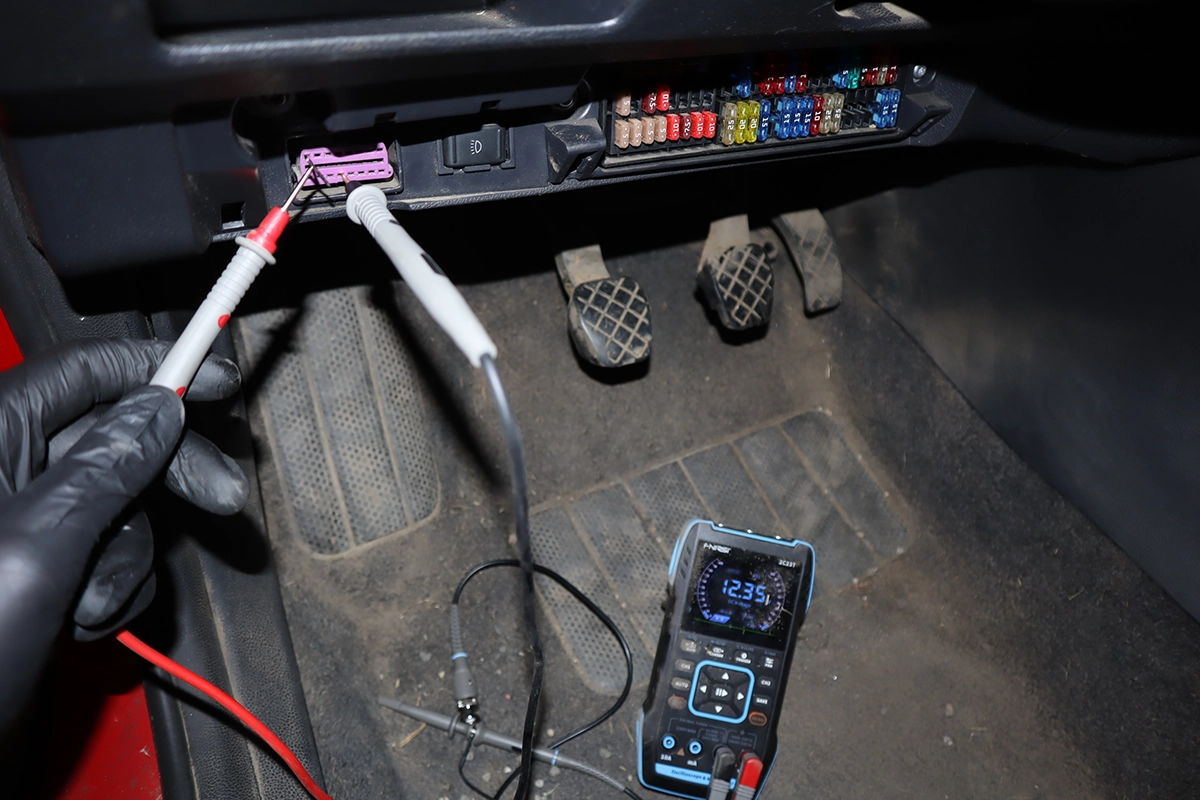
Most automotive testing only requires two multimeter settings.
Lead connections
| Lead | Port |
|---|---|
| Black lead | COM |
| Red lead | V / Ω |
Common settings
| Test | Setting |
|---|---|
| Voltage measurement | DC Voltage |
| Resistance measurement | Ω |
| Continuity test | Continuity mode |
In automotive diagnostics you will almost always measure DC voltage.
How to Measure Voltage in a Car
Voltage testing is the most common electrical test.
Basic procedure
- Set multimeter to DC voltage
- Connect probes:
| Probe | Location |
|---|---|
| Black | ground or battery negative |
| Red | wire being tested |
Example: battery test
| Reading | Interpretation |
|---|---|
| 12.6V | fully charged battery |
| 12.2V | partially discharged |
| <12V | weak battery |
During engine cranking voltage should stay above 10V.
How to Test Power at a Component
This is the most common diagnostic test.
Example: testing a sensor connector.
Procedure
- Turn ignition ON
- Connect black probe to chassis ground
- Touch red probe to power wire
Expected result:
| Reading | Result |
|---|---|
| 12V | power supply OK |
| 0V | no power reaching component |
If voltage is missing, the fault is usually between:
- fuse
- wiring
- switch
- ECU output
The 4 Most Common Automotive Electrical Faults
Most electrical problems in vehicles fall into four categories.
| Fault | Description |
|---|---|
| Open circuit | broken wire or blown fuse |
| High resistance | damaged wiring or corrosion |
| Short to power | wire connected to another power source |
| Short to ground | power wire touching chassis |
Open circuit
Symptoms:
- component does not operate
- voltage present before break
- voltage missing after break
Common causes:
- blown fuse
- broken wire
- disconnected connector
High resistance
Symptoms:
- voltage drops across wiring
- component receives low voltage
Example:
| Measurement | Value |
|---|---|
| Battery | 12V |
| Component | 1V |
Cause:
- corroded connectors
- damaged wiring
Short to power
Symptoms:
- component stays on even when switch is off
- constant voltage on control wire
Cause:
- damaged insulation touching another powered wire.
Short to ground
Symptoms:
- fuse repeatedly blows
Cause:
- power wire touching chassis.
Useful Multimeter Tools for Car Diagnostics
Helpful accessories:
- T-pins for backprobing connectors
- alligator clips for stable ground connection
- test leads with needle probes
These allow you to measure circuits without disconnecting connectors.
Hi, I am Juraj Lukacko. I got frustrated by unhelpful and scammy mechanics, so I decided to learn everything about car diagnostics myself. I test dozens of new car diagnostic tools every month along with learning new strategies to fix and customize cars.